A short history of artificial intelligence, from Turing to GPT-6
Seventy-six years in ten chapters: the ideas, the winters, the breakthroughs and the people behind today's AI. To understand why now, and what may come next.
 Mattia PanattaUpdated 13 October 202612 minBeginner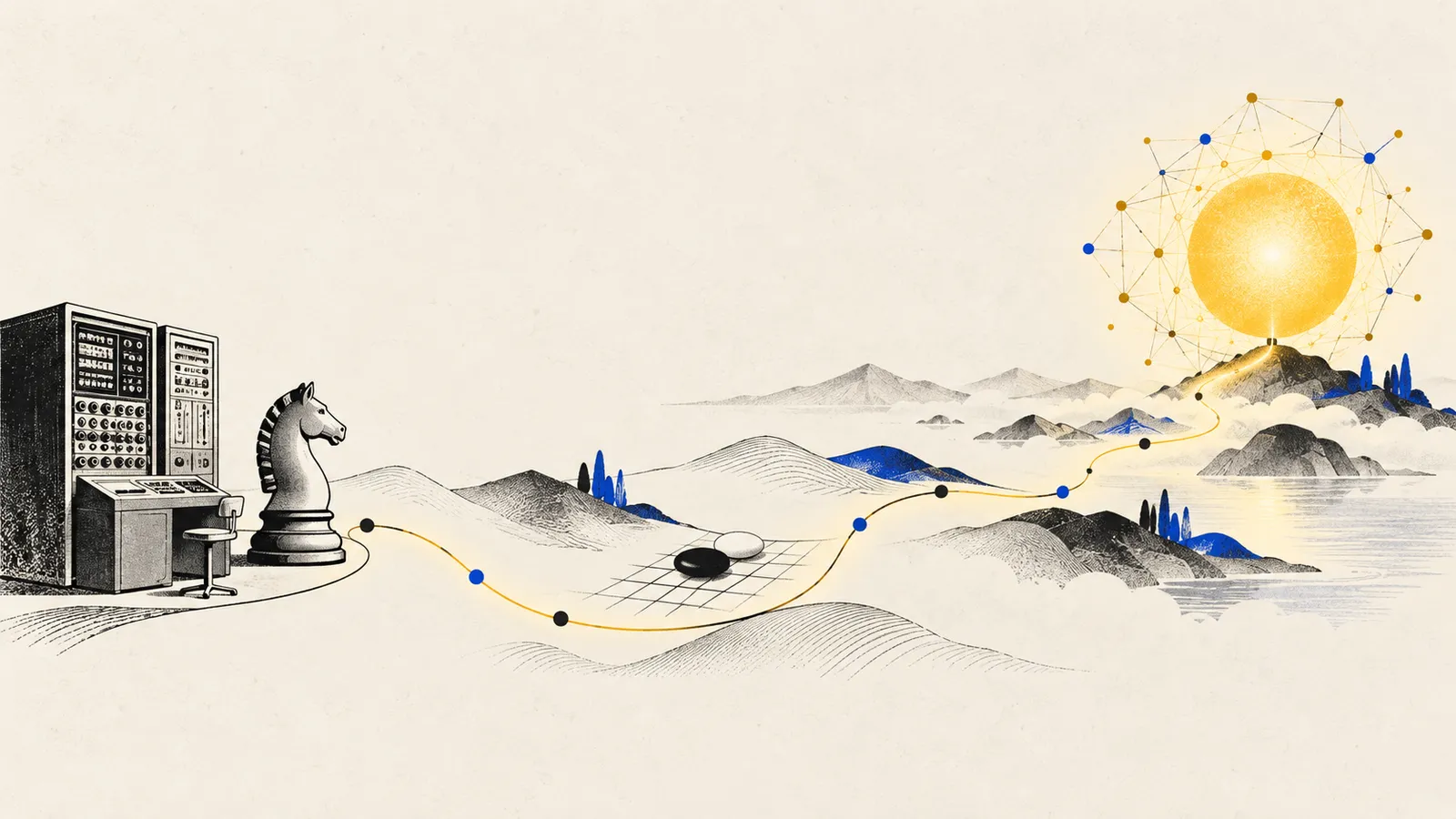
In short
- The idea of “thinking machines” is over seventy years old; the name “artificial intelligence” was born in 1956.
- For decades hand-written rules dominated; since 2012 neural networks that learn from data have won.
- Three ingredients made everything take off: data (the internet), compute (GPUs), an architecture (the Transformer, 2017).
- AI’s history is one of booms and “winters”: knowing it helps read today’s euphoria clearly.
1950: Turing’s question
In 1950 the British mathematician Alan Turing published a paper that opens with a simple question: can machines think? Instead of defining “thinking”, he proposed an experiment, the imitation game: if, conversing in writing, you can’t tell a machine from a person, what sense does it make to say the machine doesn’t think?
The Turing test was criticised for decades, but it fixed an idea we find intact in ChatGPT: judge intelligence by behaviour, not by what’s inside.
1956: a name (and an ambition) is born
In summer 1956, at Dartmouth College, a group of researchers including John McCarthy, Marvin Minsky and Claude Shannon held a workshop with a stated goal: to describe every aspect of learning and intelligence so precisely that a machine could simulate it. McCarthy coined the term artificial intelligence for the occasion.
Optimism was huge: within a generation machines would match humans, it was thought. It didn’t go that way.
1960s-80s: rules, expert systems and two winters
Early AI was symbolic: knowledge was coded as logical rules (“if the patient has fever and cough, then…”). In the 1980s expert systems had real commercial success in medicine, finance and industry.
But hand-written rules don’t scale: the world is too varied, exceptions endless. Twice, in the mid-1970s and late 1980s, funding collapsed. These were the AI winters: periods when promise far outran reality and the market noticed.
Meanwhile, on the margins, another idea survived: neural networks, loosely inspired by brain neurons, which instead of following rules learn from examples. In 1986 Geoffrey Hinton and colleagues popularised backpropagation, the training method still used today.
1997: Deep Blue beats Kasparov
IBM’s computer defeated the world chess champion. A huge media event, but technically the triumph of the old school: brute force (millions of positions per second) and chess knowledge written by experts. Deep Blue could do nothing else.
2012: the deep learning breakthrough
At the ImageNet competition, where programs must recognise objects in millions of photos, a “deep” neural network called AlexNet, from Hinton’s group in Toronto, left everyone behind. The secret: lots of data, a network with many layers, and GPUs, graphics card processors, used to run millions of calculations in parallel.
From then on deep learning became the main road. Within a few years came speech recognition, machine translation and computer vision of unprecedented quality. And NVIDIA, which makes GPUs, began turning into the company that symbolises AI.
2016: AlphaGo and “move 37”
DeepMind, the lab founded by Demis Hassabis and acquired by Google, beat Lee Sedol at Go, a game considered too complex for brute force. In game two AlphaGo played a move, number 37, that commentators judged a mistake: it was brilliant. For the first time a machine showed something like creativity in a refined human domain.
2017: the Transformer
Eight Google researchers published Attention Is All You Need and introduced the Transformer, an architecture based on attention (explained in the guide on how an LLM works). It’s more efficient than its predecessors and, crucially, improves predictably as it grows: more data and compute, better results.
It’s the key to everything that followed: the “T” in GPT stands for Transformer.
2018-2022: grow, grow, grow
OpenAI bet on scale: GPT-1 (2018), GPT-2 (2019), GPT-3 (2020), each much larger. With GPT-3 something unexpected happened: the model could do tasks it wasn’t trained for, just by reading a few examples in the text. Also in 2020, DeepMind’s AlphaFold 2 effectively solved protein structure prediction, a result that would earn a Nobel Prize.
Then, on 30 November 2022, OpenAI released ChatGPT: the same kind of model, trained to converse and made easy to use. A hundred million users in about two months. AI left the labs and entered homes.
2023-2025: the race
GPT-4, Claude, Gemini, Llama and open models arrived; image and video generators; the first agents. In 2024 reasoning models learned to “think” before answering, the EU AI Act entered into force and the Nobel prizes went to AI: physics to John Hopfield and Geoffrey Hinton for neural networks, chemistry to Demis Hassabis and John Jumper (with David Baker) for proteins. In January 2025 China’s DeepSeek showed very capable models could be built for far less than expected. Italy passed Law 132/2025.
2026: from assistants to agents
Here we are: GPT-6, Claude Opus 5.5, Gemini 4 Argon, Muse Wonder. Answers become interactive interfaces, agents work for hours, costs per task collapse. We cover it in this site’s news and opinions.
What history teaches
- Predictions err in both directions. In 1956 people thought everything would be solved in twenty years; in 2015 almost nobody imagined ChatGPT by 2022.
- Winning ideas often wait. Neural networks date from the 1950s, backpropagation from the 1980s: data and compute were missing.
- Winters come when promise outruns reality. Today the technology keeps many promises, but valuations and expectations run faster (see the opinion on the bubble).
- Behind every breakthrough are people and choices. It’s not technological destiny: it’s a human story, and we can still shape it.
Want the full story?
This is the ten-chapter version. In the Lumen ebook AI’s history is told in full, with the people, contexts and behind-the-scenes stories, alongside tools, rules and the future.
Sources
Informational content, current as of the date shown. Prices, models and rules change often: always check official sources. Written with the support of AI tools and reviewed by the author.
